
“Originally, the business was to be a part time thing for Liesl,” Todd recalls. “She thought maybe she’d hire an assistant at some point, but that was about it.”

Todd and Liesl Gibson.
Photo by Katherine Slingluff
“Opportunities began to come in and she couldn’t take advantage of them by herself. She was being asked to travel and teach, to write a book and do fabric collections,” Todd says of his wife’s early days at Oliver + S. “She needed a growth path for the business and we had to make a decision — do we want to grow this or keep it an extremely small, part time hobby?”
The couple chose growth.
A former college professor with a PhD in literature, Todd was working at an investment bank after a 10-year stretch in management consulting. Not entirely happy with his current job, Todd decided to quit and come to work for Oliver + S full-time. With their combined skills and work experience, the Gibsons were able to grow the company into a mainstay on the home sewing market.
One of the first things Liesl and Todd considered when discussing Todd’s move to full-time, was whether they could afford it.

Todd and Liesl Gibson.
Photo by Katherine Slingluff
Pattern designer Jen Beeman found herself in a similar position when her women’s sewing pattern business, Grainline, began to grow. Beeman began asking her partner, Jon Krohn, to help her during his off-hours. A graphic designer by training with experience in laying out books, Krohn was able to help Beeman create her first print patterns.
“I’d be so stressed about creating stuff for print and he’d take one look at it and say, ‘Oh, this is easy. Let me do it.’ He’d lay it out and call the printer and set it all up. It was great,” Beeman says of Krohn’s contributions.
In May of 2015, Krohn began working for Grainline full-time, taking over all of the graphic design work and managing shipping and distribution — a time-consuming task that Beeman desperately needed help with.
For other creative business owners, bringing their spouse on full-time is a future goal.
Right out of art school, Jordan Perme started making faux taxidermy creatures by carving foam and covering it in felt shapes. She called them Horrible Adorables and took them to a craft show in Philadelphia to see if they might sell. Her husband, Chris Lees, came along to help out.
“For the first show I just did the logistical stuff,” Lees recalls. “I booked the hotel room and helped her pack the car.”
Shoppers loved Perme’s quirky critters and she felt encouraged to continue making them, but cutting the felt shapes that covered each animal was labor intensive. Lees, a mechanical engineer and artist, helped to streamline production in a way that would allow Perme to create a Horrible Adorables creature quickly and efficiently enough to sell in a retail setting.
“He’s really good at spreadsheets,” Perme laughs.
Lees also makes much of the product that goes to retail stores they stock around the country while Perme focuses on more intricate fine art pieces for gallery shows.
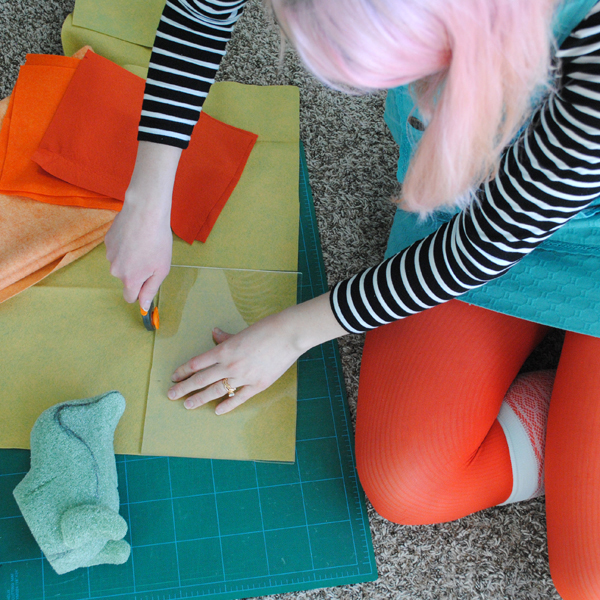
Jordan Perme cuts the felt she uses to make Horrible Adorables.
Photo courtesy of Chris Lees and Jordan Perme
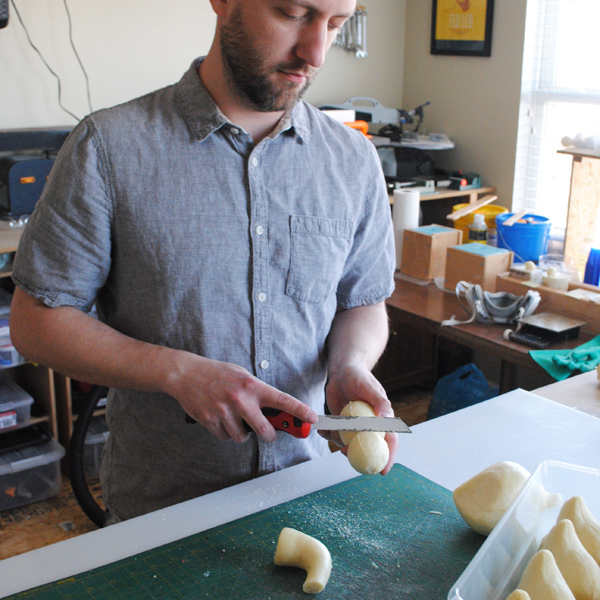
Chris Lees sculpts Horrible Adorables.
Photo courtesy of Chris Lees and Jordan Perme
“It’s a leap of faith,” Lees says. “But we’ve put money aside in savings so that even if we don’t make any profit in 2016 we can still live.”
“I’m a little nervous about having us both home all day,” Perme says. “I think it’s going to be important to be respectful of how each other work.”
Todd Gibson, of Oliver + S, agrees: “Working together will have an impact on your relationship. You’re going to be spending a lot more time with that person. You’re raising kids together, living together and now working together, so any disagreements in any sphere are going to spill over.”
Gibson recommends setting boundaries and deciding when you’ll talk about work and when you’ll leave work behind.
“I work at home and I really don’t have anything else to talk about,” Perme says. “This is all I do. Well, this summer we got beehives, so sometimes we talk about the bees.”
For some couples, the dynamic of their personal relationship helps them manage the stresses of owning a business. Beeman says Krohn is a good balance for her emotionally and that plays out in their business in a positive way.
“We get stressed out in opposite ways and he’s great at calming me down,” Beeman says.
Before bringing your spouse on full-time, consider whether their skills are complimentary to yours and are a match for what the business needs. For the Gibsons, Todd’s skills were a perfect fit.
“I’m a business person. I know how to do strategic and financial planning. I know how to do forecasting and how to focus on process. And I have the skills to build the technology we needed to grow,” he explains, adding that Liesl wouldn’t have been able to afford to hire someone at his level otherwise.
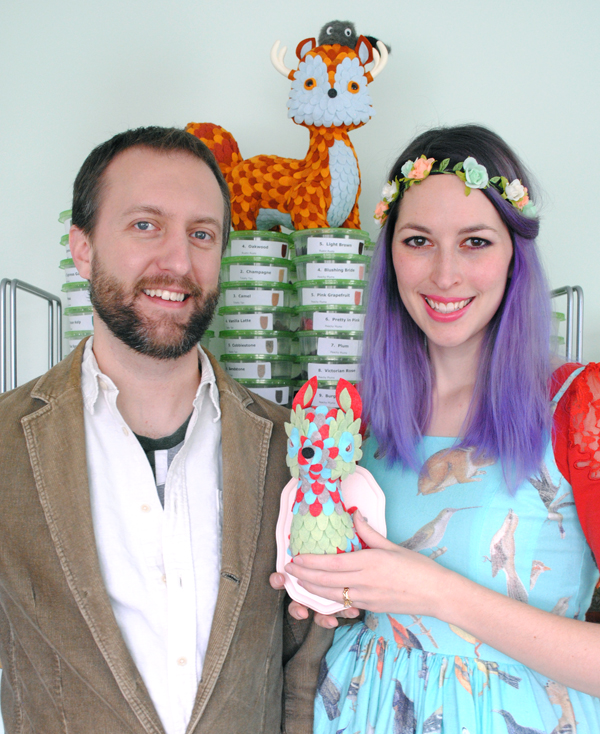
Chris Lees and Jordan Perme are hoping to work together on Jordan’s business, Horrible Adorables, full-time in 2016.
Photo courtesy of Chris Lees and Jordan Perme
“When Jon works a design job it’s $100 per page,” Beeman explains. “I can’t afford to pay that. But he said, ‘Yes, let’s build this thing together.’ If you hire someone they’re never going to say that.”
It’s also important to think through how you’ll define your spouse’s work status for legal, payroll, and tax purposes; will they be a contractor, an employee, or a partner?
The Gibsons own Oliver + S as an equal partnership while Krohn is an employee of Grainline with Beeman retaining sole ownership of the company.
“He feels like, ‘You built this company. You can own it.’” Beeman explains. “He’s not a person who feels he needs to be in charge. As a graphic designer, he was used to taking assignments from clients. Then again, we don’t really have typical gender roles. Jon does all the grocery shopping and all the cooking for us.”
Permes still has her business registered as a sole proprietorship LLC, but plans to amend that to bring Lees on as an equal partner in the coming year.
The Gibsons have rented their home in New York City to spend this year in Spain with their daughter, an experience that would have likely been impossible if they didn’t own their own business.
Being in business together doesn’t come without risk, though. When both partners’ financial futures are tied to a single business, the stakes are high. Beeman says Krohn helps her relax when she begins to worry about the risks involved.
“Jon tells me, ‘We can always go and get jobs if everything fails,’” she says.
And the Gibsons say the trade-off has been worth it: “Even now, we both make less money than we did when we were working corporate jobs, but it’s really about how you define success. If success means owning a second home and a big boat and two or three cars this wouldn’t be success, but we feel we’ve been able to use this business to escape from working for the man and being tied to an office cubicle in midtown Manhattan. This business gives us the lifestyle we want.”
+++++
Running a small business can get complicated around tax time. We’ve created a free guide to small business tax deductions to help simplify the process. Click the button below and we’ll email it to you!
I can’t even begin to express how much I love this article. After my last failed attempt to get the support of my partner (now ex), I was convinced that this couldn’t work. Obviously it can and I just need a more compatible partner to try again. By the way, Leisl Gibson is brilliant as a teacher–just brilliant!
I’m so happy to hear this, Marsha. From talking with these couples it was clear to me that in the right situation working together and be really successful. It’s not everyone’s situation, though. My husband has a great job in finance that he loves and he would be miserable working in my business (and I would be miserable working in his!).
It’s so wonderful hearing about other couples who’ve gone into crafty business together! It’s so neat hearing more about Jen and Jon’s working relationship, and more about the Gibsons. I had a little peek into the Gibson universe when I did the Creativebug Building a Creative Brand class – probably a couple years ago now – and it made it feel like a realistic option seeing how well it worked for them. And now my partner Bruno and I have followed suit (not something we ever thought would happen until we started talking about building Textillia.
I’ve been amazed at how well we actually work together – I think having very separate tasks and ownership over different parts of the business has been really helpful, and we’re also lucky to have a separate office/studio space (separate from our main living space, but still inside the home) so we don’t ALWAYS have to be in the same space 24/7. It’s quite the adventure, but for people who want to be their own boss and have a lot of flexibility and freedom, it feels very worth the risk!
I remember when Liesl Gibson was first starting out. I am a flight attendant besides in the craft industry and she was on one if my flights. She was drawing out some patterns on the plane and we started chatting. I have 4 kids and 13 grandkids and have sewed for them all and thought her designs were amazing. She was so sweet and so excited about her new company! I’m so happy for her success.
What a great story!
Great stories, thanks for the wonderful article. I worked with my partner in my music-related business for years, before the left to pursue his passion (software development). I’m working on a blueprint for a new craft-related business now, and I can already see that we’ll be able to collaborate in interesting ways in future. It’s really a special thing to have a supportive partner who is prepared to roll their sleeves up and help you succeed.
Great article! My husband and I have grown our business, Woolpets, together. We’ve learned a lot over the years, through many ups and downs. It has not been easy….managing and running a business together and a marriage. Truth be told, I had to step away from Woolpets and get a job outside of the home to ease the personal stress and pressure of working together on a business. Not just for financial reasons, although having a reliable, steady income (albeit tiny), does help with the bottom line. Learning to compromise and to be empathetic with the other person’s work style has been a huge challenge, too. We are still finding our way, each day, hour by hour. But Woolpets is still thriving. With lots of patience and kindness towards one another, it is possible!